













Comfort networks: The growing challenge of onboard network complexity
As passenger expectations continue to rise, the railway industry faces a new challenge: to keep innovating without creating unsustainable onboard complexity.
For decades, adding new onboard systems has been a sign of progress. Passenger information systems improved the travel experience, CCTV increased security, and passenger Wi-Fi brought connectivity onboard. More recently, passenger counting, condition monitoring and onboard computing have opened up new opportunities to improve operations making rail travel more efficient and increase customer comfort, helping the sector to grow.
The railway industry is entering a new phase of digitalisation and the challenge is no longer whether trains should become more connected, but how to handle the growing complexity of managing both new and legacy systems in a safe, efficient and secure way.
Passenger expectations are changing
The way people use trains today is different from just a few years ago. Passengers expect reliable connectivity throughout their journey. Streaming video, online services and digital experiences that were once considered optional are now core expectations of modern transport systems. Poor onboard connectivity is no longer a minor inconvenience – it directly affects how passengers perceive the service and is often near the top of the complaints list when it isn’t working properly.
Operators are also under pressure to improve efficiency, increase ridership and support broader sustainability goals. Better passenger experiences are becoming an important part of encouraging more people to choose rail instead of other modes of transport. As a result, onboard systems continue to expand and offer ever-increasing services enabled by reliable connectivity, ultimately improving the comfort and security of those onboard.
The digital train is generating more data than ever
Alongside passenger-facing services, train systems are becoming increasingly interconnected harnessing intelligence across multiple systems and networks.
Sensors now monitor everything from train condition and environment, to operational performance with optical sensors from CCTV systems evolving into powerful sources of operational insight. Harnessing this information, condition monitoring and predictive maintenance applications are helping operators make more informed decisions to reduce disruption and increase maintenance cycles. Looking ahead AI and analytics are expected to play a growing role in turning this data into actionable information across many operational areas such as train movements, scheduling, ticketing and passenger demands.
All of these developments create value for operators and passengers, but they also place new demands onto the onboard network. More devices, more data and more connected services require careful management of onboard networks, particularly when new systems need to coexist with existing legacy infrastructure.
The hidden cost of innovation
The rail industry has traditionally solved new requirements by introducing new systems. Especially replacement of analogue systems with arguably more effective digital platforms requiring new hardware, new infrastructure and quite often on entirely separate networks.
Initially this works well, where each application can be delivered independently and optimised for its specific purpose. Over time however, the result can be a train populated with many under-utilised networks, duplicate devices and usually multiple management platforms. What was originally intended to simplify deployment can gradually increase operational complexity, especially as we’re now hitting the first wave of legacy IP networks implemented in the 2000s needing replacement.
For operators, this can create several challenges:
- More hardware to maintain across multiple vendors and integrators
- Unmanageable firmware updates across fleets
- Increased cybersecurity workload
- More space consumed onboard, within couplers and inter-carriage jumpers
- Reduced RAMS performance across the fleet
The issue is not that the additional services lack value. The issue is that every new service adds complexity that must be managed throughout the lifetime of the train.
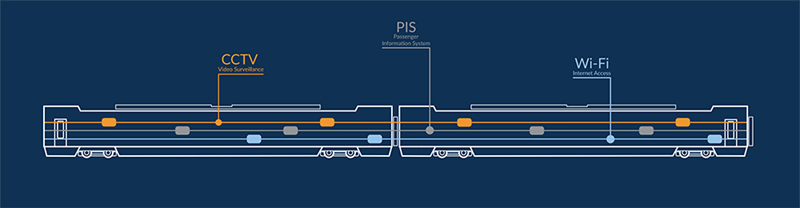
Multiple networks supporting onboard services
Complexity is becoming a challenge
As digitalisation accelerates, complexity itself is starting to become a limiting factor. Many operators want to introduce additional passenger services, leverage operational data more effectively and deploy future technologies such as AI-driven analytics. Yet each new service addition increases the demands placed on existing infrastructure.
At the same time, rolling stock designers face practical constraints. Space onboard ageing vehicles is limited, power budgets are finite, and existing fleets often contain equipment from multiple generations and suppliers. Integrating new services into these environments becomes increasingly challenging over time and methods should be sought to add value to the train ecosystem with each new service.
The question therefore becomes: How can operators continue adding value without continuously adding complexity?
A different approach to onboard networks
To answer that question, the industry is beginning to look beyond individual applications and focus on the underlying infrastructure. Rather than thinking about passenger Wi-Fi, CCTV, passenger information or monitoring systems as isolated projects with individual networks, operators and train builders are exploring how these services can coexist on more capable, scalable network architectures.
The goal is not simply to support today's requirements. It is to create a foundation of connectivity that remains manageable as the next generation of onboard services emerges, because the future of rail is undoubtedly more connected. Reducing complexity now will undoubtedly act as a catalyst for future growth for our industry which will benefit us all.
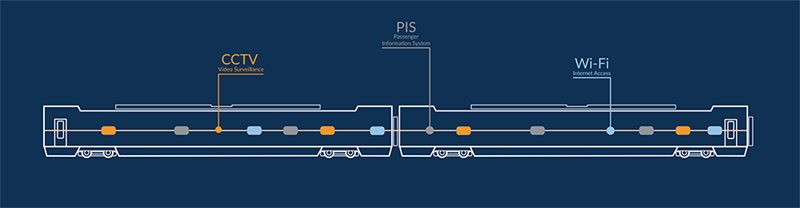
A consolidated, scalable comfort network
By Mark Gibbs

See also

Nuri Shakeer
International Sales

Bei Supportanfragen, hier klicken, um den technischen Support zu kontaktieren