







FRMCS: The Future Railway Mobile Communication System
What is FRMCS?
The railway industry is entering a new era with the Future Railway Mobile Communication System (FRMCS), a standard designed to replace the aging GSM-R system and enable the digital transformation of railways worldwide.
At Westermo, we are proud to be part of this journey, working alongside industry organizations, operators, and technology partners to create open, future-proof solutions for mission-critical rail networks. Through ETSI and UNIFE, Westermo is taking an active role in standardization of FRMCS.
Transition from GSM-R to FRMCS
FRMCS (Future Railway Mobile Communication System) is the designated successor to GSM-R, the 2G-based system currently used for railway communications across Europe. GSM-R is being phased out due to its limited capacity, outdated architecture and availability of components, and inability to support modern digital services. FRMCS, by contrast, is built on open standards, including 5G, and is designed to support a wide range of services including signaling, voice, video, diagnostics, and passenger connectivity.
FRMCS vs GSM-R
GSM-R is based on 2G; FRMCS is based on 5G (3GPP Release 18), with support for railway-specific bands (n100/n101) and broader wireless technologies like Wi-Fi, mmWave, and satellite.
GSM-R supports limited voice and data; FRMCS enables multi-service support including MCX (Mission Critical Communications), ETCS, ATO, CCTV, and Passenger Information Systems.
GSM-R relies on dedicated infrastructure; FRMCS supports hybrid models with roaming across private and public networks, allowing aggregation of multiple wireless technologies.
FRMCS is designed to evolve with future 3GPP releases and supports modular onboard systems through interfaces like OBRAD, enabling long-term adaptability.
Westermo’s Role in Enabling FRMCS
At Westermo, we are committed to standardised, interoperable interfaces that align with UIC’s vision of FRMCS. Interoperability is essential to ensuring vendor independence, promoting innovation and enabling a resilient multi‑supplier ecosystem. To support this, the UIC is standardising the interfaces between the key components of the FRMCS system. One of the most critical is:
OBRAD - On‑Board Radio Interface.
OBRAD defines the interface between the wireless communication devices and the gateway functions on the train. This specification is central to achieving a modular and interoperable FRMCS architecture.
Current technical specification: ETSI TR 104 006 V1.1.1 (2025‑01)
Formalisation underway: ETSI TS 104 127 V0.0.1 (2025‑04)
Westermo actively follows and supports this standardisation work to ensure that our onboard networking solutions are fully aligned with FRMCS requirements. With decades of experience in secure wireless railway communications, Westermo combines trusted industry know-how with agile, forward-thinking solutions for FRMCS.
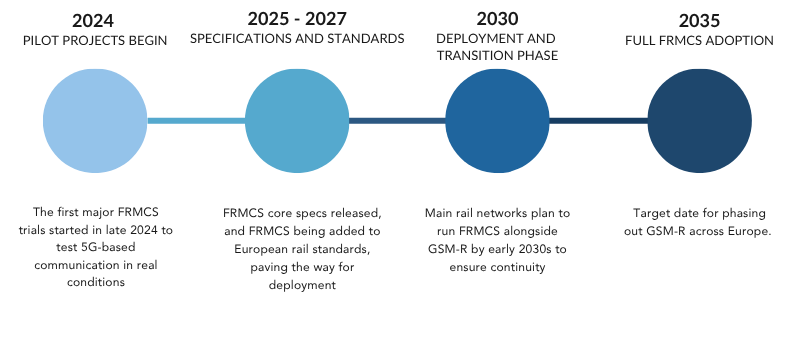
FRMCS Deployment Timeline
Key Milestones Toward Full Adoption
The rollout of FRMCS is a multi-phase process coordinated by European rail authorities, industry groups, and technology vendors. The deployment of FRMCS is structured around a phased transition, ensuring continuity of operations while enabling modernization.
Why Westermo?
Your Partner for Mission-Critical Networks
Westermo has a long-standing reputation for delivering reliable, secure, and innovative networking solutions for the rail industry. As the sector transitions to FRMCS, we are committed to being more than just a supplier. We are your partner. We work closely with operators, infrastructure managers, and system integrators to understand your needs and develop solutions together that truly match your needs.

Daniel Samo
Head of Product Management DACH, FRMCS Expert

För supportärenden, klicka här för att kontakta teknisk support