













WeConfig: A simpler way to manage industrial networks throughout their lifecycle
Industrial networks rarely stay the same. Devices are added or replaced over time, configurations change, firmware needs updating and problems need to be investigated. It's all part of keeping a network running, but managing it device by device can quickly become very time-consuming.
We spoke with Joel Cummings, Global Solution Director for Software at Westermo, about what WeConfig is, where it fits in an industrial network and how it can make building and maintaining networks simpler.

What is WeConfig?
For Joel, WeConfig is an engineering tool for configuring and maintaining networks. Rather than treating configuration as something that ends at commissioning, he sees WeConfig as supporting the network throughout its lifecycle.
“It’s configuration and lifecycle management for your network.”
That lifecycle perspective is important because an industrial network continues to change after it is up and running. Devices may be added or replaced, configurations adjusted and firmware updated. Engineers also need to troubleshoot problems and adapt the network as requirements change.
It helps to be clear about what WeConfig is not. Joel describes it as an engineering tool rather than a traditional network management system (NMS) designed to continuously monitor a network. Its role is different: helping engineers build, configure, change and maintain the network.
Moving beyond device-by-device configuration
One of the challenges Joel highlights is the repetitive work involved when devices are handled individually. Traditionally, an engineer may have to connect to each device, log in and work through its configuration manually. As more devices are involved, the amount of time-consuming work increases.
WeConfig provides a common environment for working with multiple Westermo devices. Engineers can make configuration changes and deploy them across selected devices instead of repeating the same process one device at a time.
In practice, this means less repetitive configuration work and a more consistent way to make changes.
Why does seeing the whole network matter?
This is where Joel sees the visual approach as particularly useful. WeConfig can show the physical topology of the network, including how devices and ports are connected. It can also visualise other aspects of the network, such as subnets, VLANs and rings. Instead of building up an understanding device by device, engineers get a wider view of how the network fits together.
“Some people are very visual, some are happier working from a spreadsheet. I think this suits both.”
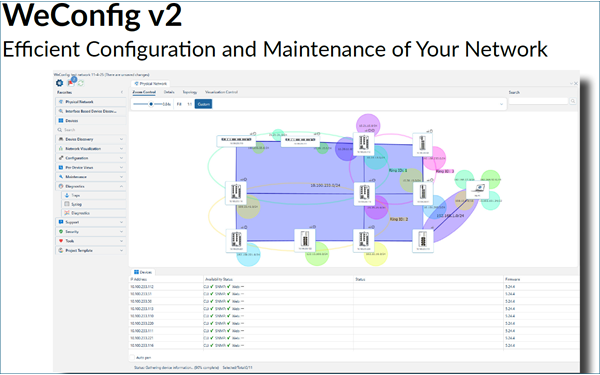
That wider view becomes especially useful in deployed industrial networks. Physical connections may run through cabinets and ducts or across longer distances between buildings, making the network difficult to understand simply by looking at individual devices. Having the topology visible gives engineers useful context before they make a change or start investigating an issue.
That context continues to matter after commissioning, as new equipment may be introduced, configurations need adjusting and existing systems have to keep working alongside those changes.
How does WeConfig support ongoing maintenance?
Firmware management is one example. WeConfig gives engineers visibility into the firmware running on devices and supports firmware deployment to Westermo devices. Instead of treating firmware updates as a separate device-by-device task, engineers can manage them within the same environment they use to understand and configure the network.
Troubleshooting benefits from the same network-wide perspective. As Joel explains, troubleshooting can be part of many different tasks, whether it's fixing a problem, integrating a new system or making changes for cybersecurity reasons. Being able to see the surrounding network gives the engineer more context about where to start looking.
So WeConfig is not only useful when a network is first configured. The same tool can continue to support engineers when they return to the network later because something needs to be changed, maintained or investigated.
More flexibility for how engineers work
Another recent development is support for Linux alongside Windows, giving engineers more choice in the environment they use for WeConfig. For Joel, that flexibility reflects the different ways engineers prefer to work. WeConfig on Linux provides both a graphical interface and a command-line option.
The aim remains the same: to make it easier to understand, configure and maintain networks built with Westermo devices.
A network keeps changing, and the tools need to keep up
Ultimately, Joel comes back to a simple idea: WeConfig should make building and maintaining networks of Westermo devices easier.
By bringing network visualisation, configuration, firmware management and support for troubleshooting into a common engineering environment, engineers can spend less time managing individual devices and more time working with the network as a whole.
As industrial networks and engineering workflows change, Westermo continues to develop the tool to support the people who build and maintain them.

Manage your industrial network more efficiently
Discover how WeConfig can help you configure, manage and maintain your industrial network more efficiently throughout its lifecycle.
Explore WeConfig capabilities
Obtenir WeConfig
Inscrivez-vous ici pour télécharger la dernière version de WeConfig
Data sheet WeConfig
Téléchargez la fiche technique WeConfig pour un bref aperçu des fonctions et des avantages.
Guide utilisateur WeConfig
Ce guide complet couvre toutes les fonctions de WeConfig
Carl de Bruin
International Sales

Pour toute demande d’assistance, cliquez ici pour contacter le support technique